




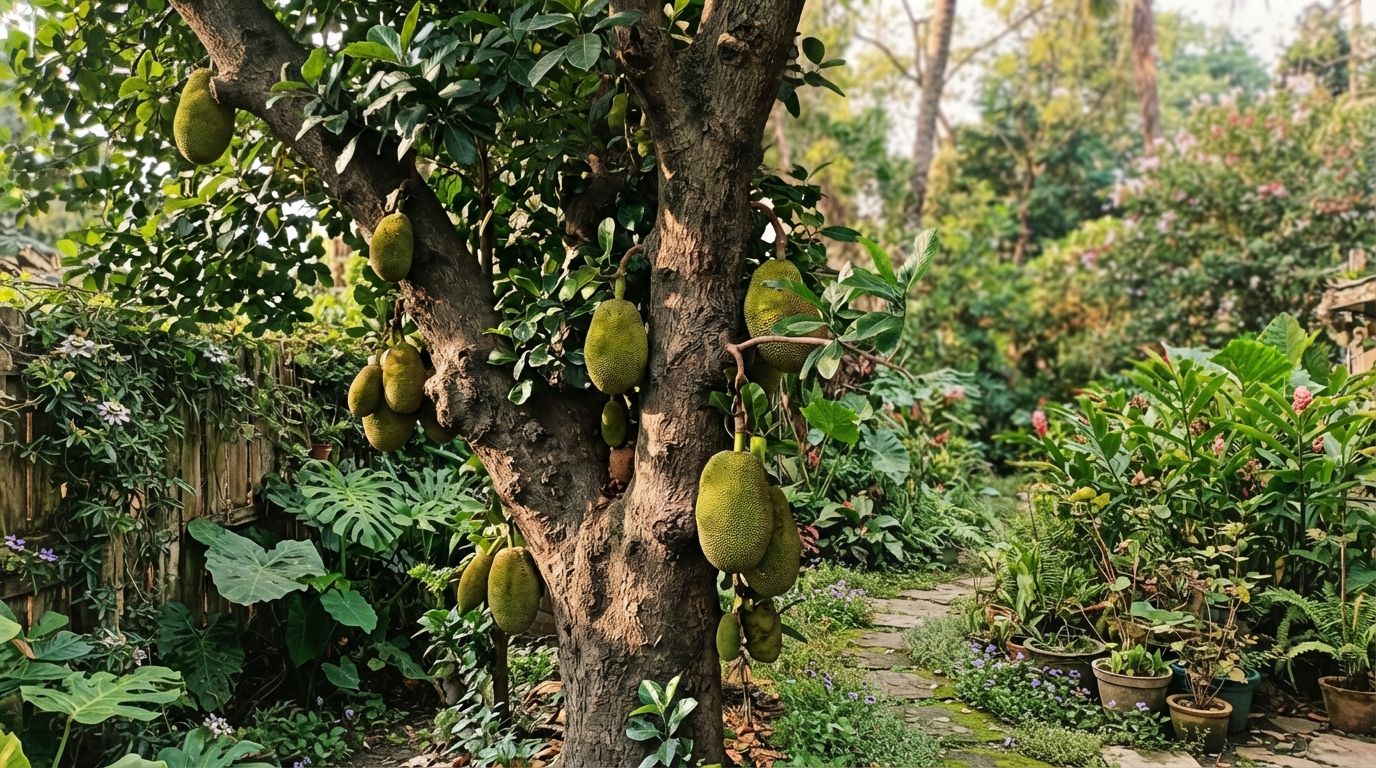
I call him Jack. To a botanist he is Artocarpus heterophyllus, a tropical evergreen, but the name is too small for what has passed between us. He stands behind the flat where I live, rooted in a narrow strip of earth, and I planted him fifteen years ago. Seasons have turned since then. People have come and gone. Jack has stayed, and he has taught me one thing above all: the strongest work in a life is often the work nobody sees.
For years he was the first living thing I saw each morning. Before the news, before conversation, before the day began pressing in, there he was at the window, green and patient in the early light. Some of his branches reach all the way to the building and brush against the window net, leaf on mesh. It is a soft sound, like a neighbour tapping gently at the door because he does not want to wake the house.
Our friendship never had a beginning I can point to. There was no morning when I decided the tree had become more than a tree. It grew through repetition. I watched his young leaves darken from pale to deep green, saw him bright at breakfast and black against the evening sky, and somewhere in those years looking at Jack became part of what home meant. He never said a word, and still we talked.
In the dry season, when the heat climbs to around 32°C, his canopy gives shade. I cannot say how many degrees he takes from the room, but I can feel the difference when I stand near the window. Sunlight that would have hit the wall in one hard sheet arrives broken into small, moving pieces, and the air beneath him is softer. In those weeks his shade is not an idea about the environment. It is a kindness I feel on my skin.
When heavy rain comes in on strong wind, Jack moves differently. His leaves shake, his thinner branches bend low, and water runs from leaf to leaf before it drops to the ground. He cannot stop the storm, and I would never claim he takes the whole force of it. But his dense foliage stands between the open sky and my window, and from inside I watch him receive what the clouds let go. He looks fragile and strong at once, bending and trembling, and he does not leave the ground.
The plants around him have not always come through each season so well. Some lose their leaves, dry back, or vanish. Jack usually stays richly green. That is no proof that he is beyond hardship, because even a jackfruit tree can struggle through drought, cold, flooding, or disease. It only means that this tree, in this place, has found a way to live with what the climate brings. His leaves help: they are thick, glossy, and leathery, and that firm skin slows the loss of water. Even so, he depends on light, rain, air, soil, fungi, insects, and the people who look after him.
That is what moves me most about his resilience. It is no miracle set apart from nature. It is biology itself, quiet and continuous. Inside every leaf, pigments catch the light and turn it into food. Tiny openings control the passage of air and water vapour. Roots draw water and minerals out of the dark soil, and the trunk carries them up to the canopy. All of this goes on without a pause, and I see none of it. I see only the green that results.
Then there is the fruit, the strangest gift he gives. It grows straight out of the trunk and the heavy branches, and it can reach a remarkable size. Ripe, it is sweet and fragrant. Unripe, it can be cooked into a savoury dish. It offers carbohydrate, fibre, vitamin C, and potassium, though the amounts change with ripeness and variety, so I will not call it a cure-all. The leaves have a place in traditional medicine too, used in some communities for inflammation and high blood sugar. Laboratory studies are interesting, but they do not show that leaf tea or a poultice safely treats diabetes in people. I respect that old knowledge enough not to exaggerate it.
Still, what Jack means to me cannot be written in a botanical description. Facts help me understand him, but only the years of friendship have taught me to see him. I have watched birds rest in his branches and insects cross his leaves, and I have seen sunlight collect on his upper crown at the end of the day. When I stand beside his trunk, I can feel the roughness of the bark and the softness of a new leaf in the same moment. Each small detail calls me back to attention.
Jack also shows me that strength does not announce itself. I sometimes say he does not need anyone’s approval, though I know that is my own human language laid over a tree. What I mean is that his life is not a performance. His real work goes on whether or not anyone is watching. He sends roots into the dark, mends small injuries, builds new tissue, and turns sunlight into stored energy. His growth shows, but the labour behind it stays hidden.
Human life can grow crowded with appearances: how we are seen, how fast we succeed, how well we display our progress. Not everyone lives that way, and showing the world what you are doing is not always shallow. Still, I know how easily my own attention drifts from the slow forming of the inner life to the wish to be admired. Jack offers another picture. Growth can be slow, local, and unseen. A strong branch begins in activity no camera can catch, and fruit comes only after long preparation.
None of this is an invitation to withdraw from other people or to pretend we need no help. Jack is not self-sufficient either. He relies on rain, soil, sunlight, pollinators, and the decomposers working beneath him. His inner strength is powerful because it is joined to all of these. In the same way, resilience in a person does not have to mean isolation. It can mean learning to receive help, to use what is at hand wisely, to endure difficulty without denying it, and to keep growing alongside others.
A few hours ago I took the photographs for this post. Standing in front of Jack again, I felt like I was meeting an old friend after a long absence, though he had never gone anywhere. Perhaps I was the one who had been away, busy and distracted, walking too quickly past a presence that had kept me company for years. I looked at his leaves, his wide branches, the familiar shade beneath him. The reunion was quiet, but it carried the weight of fifteen years.
I do not know how many more years Jack will stand there. Trees are living things, not monuments, and no amount of affection can shield them from every threat. For now he is still rooted behind my home, imperfect, responsive, and alive. His green does not tell me hardship is unreal. It tells me that a life can carry on through inner work and the support of others. The world sees leaf, branch, and fruit. Beneath them lie roots, exchanges, small adjustments, and time. Jack asks me to honour that hidden labour, because it is from such depth that anything nourishing grows.