




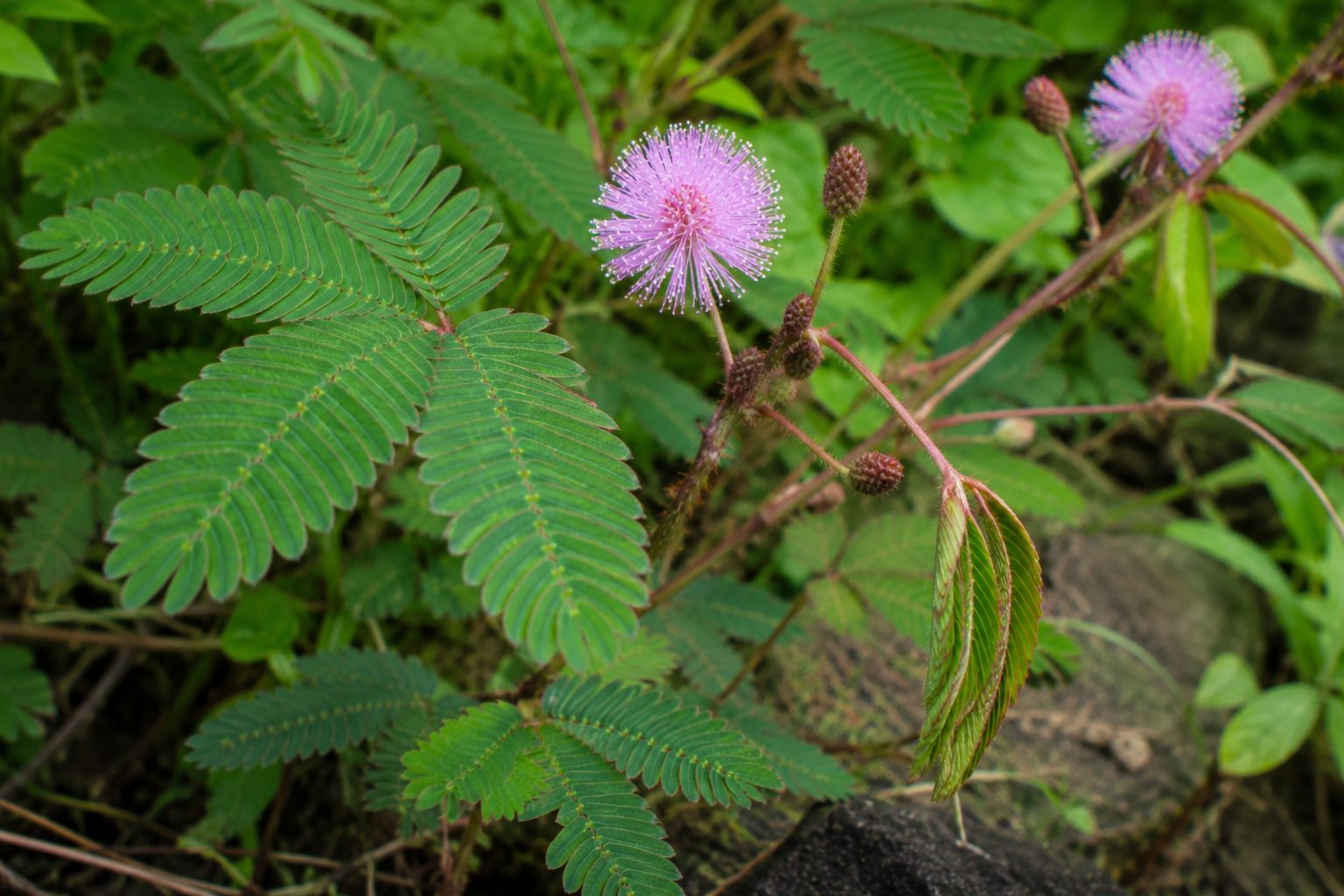
Touch it and it folds up in seconds. Science can tell you how. But what did it mean to the people who grew up watching it? An imagined conversation with the sensitive plant, Mimosa pudica.
How the Fold Works
Me: Hey, Mimosa. I’ve always wondered about that folding thing you do. I know scientists call it thigmonasty or seismonasty, but can you actually walk me through how it works?
Mimosa Plant: Sure. It comes down to a few specialized structures and some physiological mechanisms working together.
Me: What exactly lets you fold so fast?
Mimosa Plant: Well, it all starts with my pulvini, the swollen, joint-like motor organs that control my leaf movement. Smaller pulvini, often called pulvinules, occur at the base of each leaflet, while larger pulvini control the movement of entire leaf segments.
Me: So how does the pulvinus actually kick things off?
Mimosa Plant: When something touches or disturbs me, an electrical signal shoots through my tissues. Once it reaches the pulvinus, it sets off a chain of biochemical reactions.
Me: And then what happens?
Mimosa Plant: That signal opens mechanosensitive ion channels in my motor cells. Potassium and chloride ions move across the cell membranes, water follows right behind, and the osmotic balance shifts.
Me: And that shift is what makes the leaves fold?
Mimosa Plant: Right, it makes the pulvinus cells lose water fast, and the turgor pressure inside them drops.
Me: So the cells on one side of the pulvinus lose turgor, creating an imbalance that bends the leaf joint?
Mimosa plant: Exactly. The movement results from unequal pressure on the two sides of the pulvinus, and it happens within seconds.
Me: That’s quick. Thanks for walking me through it.
Mimosa Plant: Anytime. Anything else you’re curious about?
Me: Actually, yeah, one more thing. If you get uprooted, do your leaves reopen?
Mimosa Plant: Not right away, no. If my tissues are still hydrated and undamaged, the pulvini can keep working for a while even after I’m uprooted. But without roots to keep my water balance steady, closing and reopening gets harder and harder, and eventually it stops altogether.
What’s in a Name
Me: Your name’s pretty unusual. Where does it come from?
Mimosa Plant: Mimosa comes from the Greek word mimos, meaning mime or actor. People picked that because of how I fold when touched: close up fast enough that early observers thought I was mimicking an animal’s deliberate movements.
Me: So Mimosa is about the mimicking. What about pudica?
Mimosa Plant: Pudica comes from the Latin pudicus: shy, bashful, modest. It’s about how sensitive I am to touch. My leaves fold and droop the moment something disturbs them, which looks a lot like shyness or withdrawal. That’s where “shy plant” comes from.
The science made sense. But it wasn’t the whole story, not for me. I kept thinking about what the elders back home used to say about this plant.
Science and Story
Me: Growing up in western Nigeria, I heard Yoruba stories about spirits living in your leaves. Your explanation, all signals and turgor pressure, doesn’t leave much room for that.
Mimosa Plant: Only if you expect every story to work like a scientific theory. Science explains how my leaves fold, it doesn’t settle what that movement has meant to the people who’ve watched me do it all these years. A mechanism and a meaning don’t have to compete.
Me: So the stories don’t replace the science, but the science doesn’t erase the stories either.
Mimosa Plant: That’s it. They just need to be approached differently. Scientific claims need evidence. Cultural and spiritual interpretations need context, and real attention to the communities they come from. The mistake isn’t asking different questions, it’s mixing up the answers.
Me: So maybe your folding says as much about how we humans interpret the world as it does about plant physiology.
Mimosa Plant: That’s probably where we should pick this up next time: your traditional medicinal uses and what modern research has actually confirmed, and what it hasn’t.
Your Turn
Maybe that’s the real question here: what plant did you grow up with, and what did the people around you say about it? Somewhere between the pulvinus and the folklore, there’s probably a story you haven’t thought about in years.