




Africa as a Source of Knowledge, Not Just an Object of Study
For centuries, Africa has been studied, classified, and explained through intellectual frameworks developed largely outside the continent. What if Africa is not simply a place to be studied, but a source of knowledge that can change how the whole world understands itself?
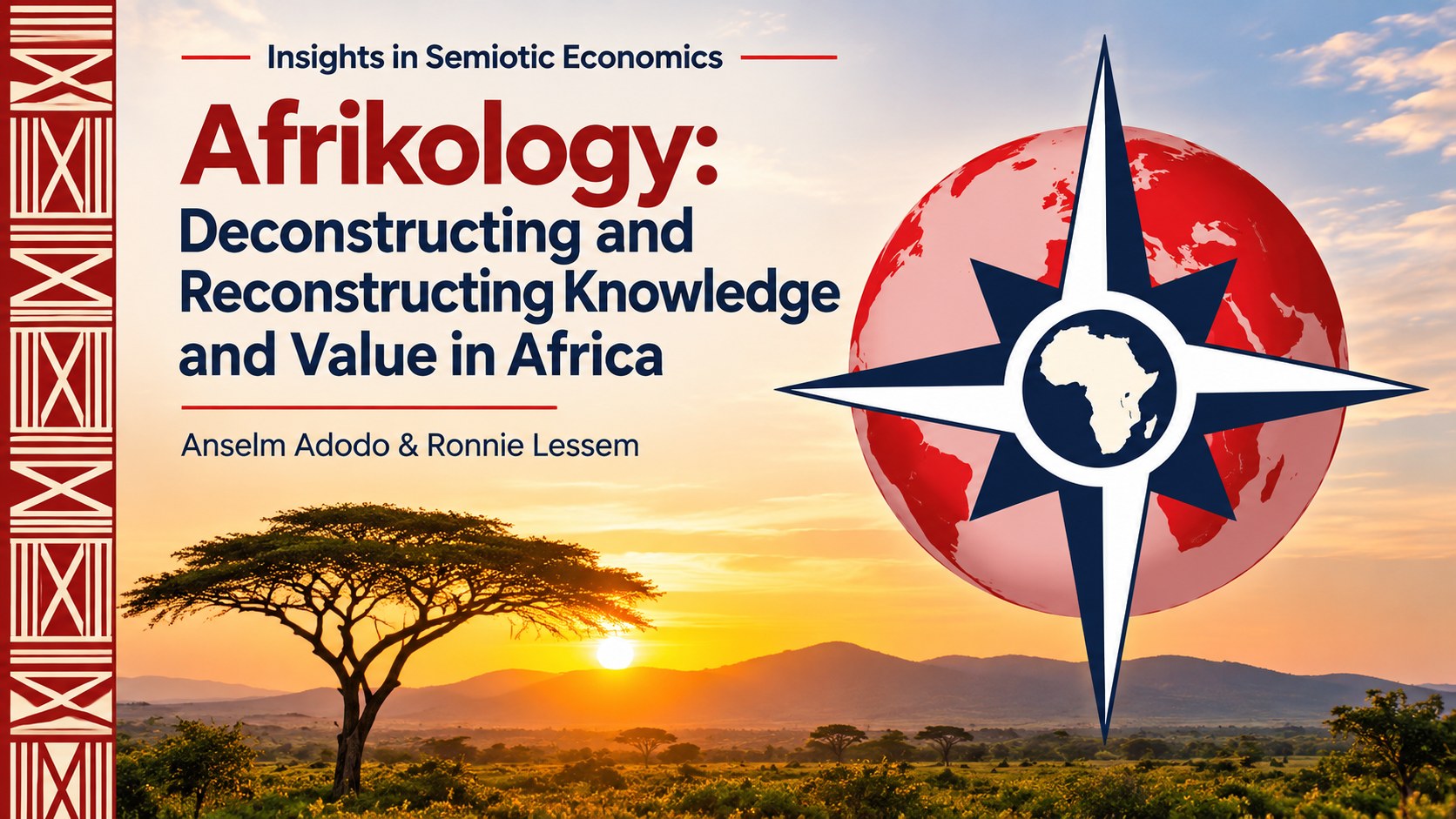
That question lies at the heart of Afrikology. In our book, Afrikology: Deconstructing and Reconstructing Knowledge and Value in Africa, Ronnie Lessem and I challenge the assumption that Western intellectual traditions set the universal standard for all knowledge. We do not propose replacing Western dominance with African dominance. We propose a more inclusive, relational, and creative understanding of knowledge. No civilisation has a monopoly on wisdom, and no society can develop by abandoning the cultural and ecological foundations of its existence.
What Is Afrikology?
Afrikology is both a philosophy of knowledge and a framework for social transformation. Its name carries two layers of meaning. “Afri” draws on Africa, where humanity’s earliest history is rooted and where traditions of thought, spirituality, healing, and communal life have developed over millennia. “Ko(logy)” invokes the Logos, the creative principle, or ordering word, through which existence acquires order and meaning. It points to an ecological way of knowing that emerges through relationships between people, communities, and the living world.
Knowing, then, is more than accumulating facts. It means understanding relationships, recognising responsibilities, and applying insight to improve life. Afrikology asks not only what we know, but how we know, why we know, and what we do with it.
Why Africa Has Been Studied but Rarely Heard
Modern academic scholarship grew up alongside European expansion and colonial administration. Area Studies, for example, divided the world into regions to be investigated, and some of its foundations were tied to colonial governance and unequal power. Africa often appeared as the object of research while intellectual authority stayed in institutions outside the continent.
African Studies and Black Studies have made indispensable contributions by challenging racism, recovering neglected histories, and creating space for African and diasporic voices. Afrikology asks the next question: can critical scholarship move from analysing oppression to creating practical alternatives? Critique matters, but it cannot by itself restore degraded ecosystems, transform rural economies, or strengthen healthcare systems. Afrikology therefore calls for a movement from intellectual deconstruction to creative reconstruction, generating new possibilities rooted in the knowledge and lived experience of communities.
Recovering Africa’s Philosophical Foundations
Afrikology draws on several streams of African thought: the ancient civilisation of Kemet (ancient Egypt), cosmological traditions, indigenous ecological knowledge, and contemporary African philosophy. These do not form a single, uniform philosophy, and Africa’s intellectual diversity is immense. What they offer is a way of resisting the fragmentation of human experience. In many African traditions, the individual is understood through relationships with family, community, ancestors, land, and the natural world.
Ubuntu, the idea that our humanity is realised through others, captures this. Knowledge is not separated from ethics, healing from community, or prosperity from ecological well-being.
From Fragmented to Integral Understanding
Modern education prizes specialisation. It has produced remarkable achievements, but also fragmentation: economics without ecology, medicine without culture, technology without ethics. Drawing on the Ugandan philosopher Dani Wadada Nabudere, Afrikology treats knowledge as transdisciplinary (crossing the boundaries between academic fields) and relational.
We extend his vision into the Communiversity: a kind of learning hub that connects community learning, cultural and spiritual growth, academic research, and practical enterprise. The aim is not to dilute scientific rigour, but to broaden the purposes and participants of knowledge creation.
GENE-IUS: Four Dimensions of Transformation
The central concept of our framework, GENE-IUS, describes four interconnected dimensions of transformation:
- Grounding (local identity): rediscovering the ecological, cultural, historical, and communal foundations of development.
- Emergence (creative encounter): bringing indigenous knowledge into dialogue with other traditions.
- Navigation (knowledge creation): developing theories, methods, institutions, and strategies that guide change.
- Effect (practical transformation): turning knowledge into sustainable enterprise, community development, and institutional renewal.
These dimensions form a continuing cycle, not a rigid sequence. Development is neither the wholesale rejection of tradition nor the uncritical imitation of modernity. It is a creative process through which societies renew themselves while staying connected to their identities.
Afrikology in Practice: SEKEM and Pax Herbals
Our book examines two examples. SEKEM in Egypt integrates ecological agriculture, education, enterprise, and cultural development, restoring degraded environments while creating social and economic value. Pax Herbals, established within the Benedictine monastic community of Ewu, Nigeria, brings African medicinal plant knowledge into dialogue with scientific research, healthcare, ecological responsibility, and community enterprise.
The principle is that indigenous knowledge should be neither romanticised nor dismissed, but documented, investigated, critically evaluated, and developed responsibly. These initiatives do not claim that every traditional practice is scientifically validated, or that local knowledge is automatically superior. They show how inherited wisdom can become a starting point for research and innovation.
Afrikology and the Future of Humanity
Our world faces interconnected crises: ecological degradation, widening inequality, cultural alienation, technological disruption, and eroding communal ties. Technical fixes alone will not meet them. We must reconsider the values that guide progress. Afrikology invites societies to move beyond the assumption that development means becoming more like the industrialised West, and to discover their own creative possibilities while learning from others.
For Africa, that means recovering intellectual confidence without cultural isolation. For the wider world, it means recognising that African traditions of relationality, ecological responsibility, and communal learning can contribute to human flourishing.
Afrikology is neither an exclusively African project nor a nostalgic return to an imagined past. Its promise lies not only in restoring Africa’s place in the history of knowledge, but in helping humanity rediscover knowledge as a shared responsibility for life. The future will not be shaped by one civilisation thinking for the rest. It will emerge from the creative encounter of many worlds, each contributing its wisdom to a more humane, balanced, and sustainable civilisation.
Want to go deeper? Afrikology explores these ideas in full, including the GENE-IUS framework and the case studies of SEKEM and Pax Herbals.
Adapted from Afrikology: Deconstructing and Reconstructing Knowledge and Value in Africa, by Ronnie Lessem and Anselm Adodo.