




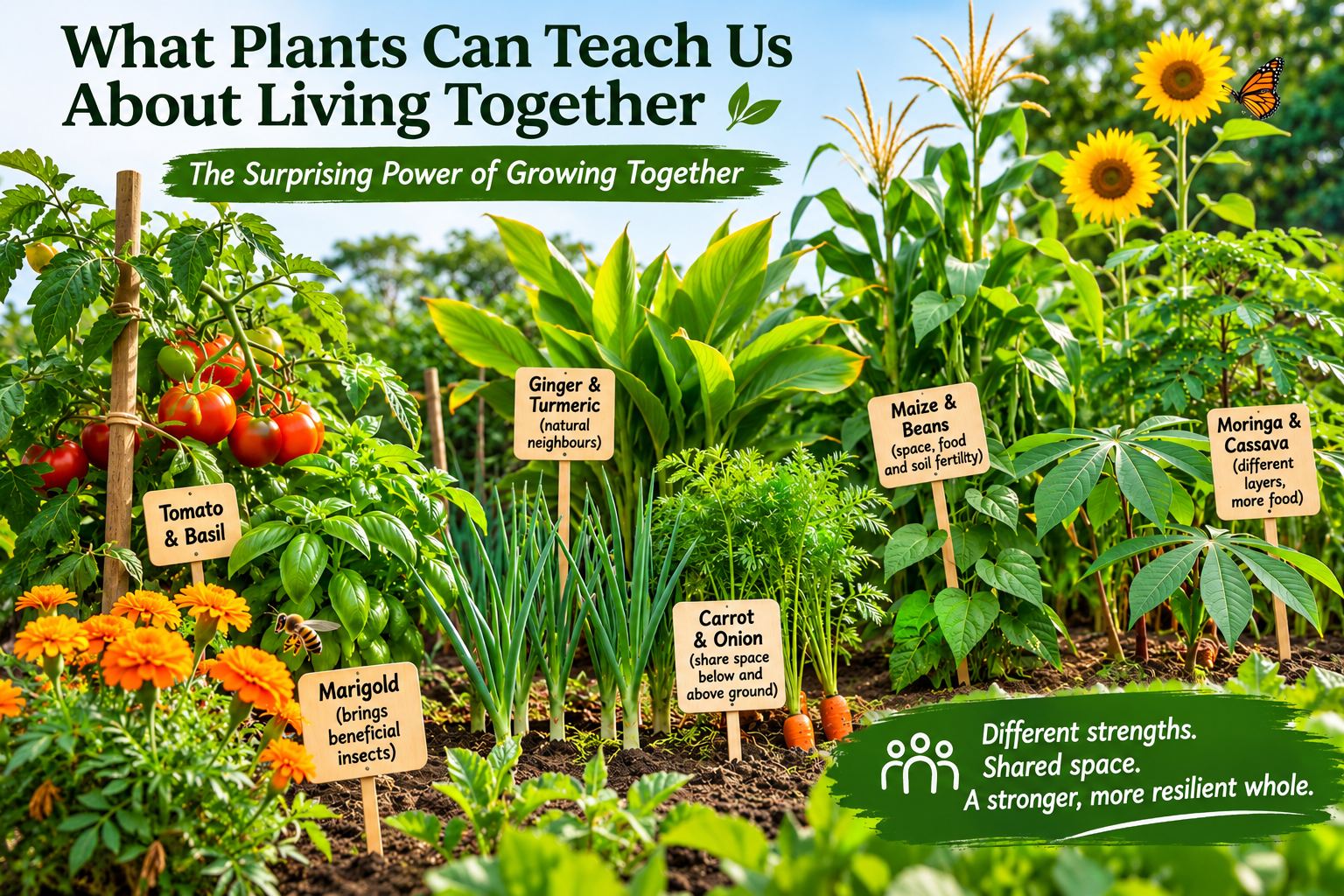
The Surprising Power of Growing Together
We tend to picture nature as a relentless contest: every plant reaching for the same sunlight, water, and patch of soil. Look closer, however, and another story emerges. Many plants thrive through relationships. One may draw in pollinators, another shelter the soil, and another help nutrients circulate through an ecosystem. These partnerships can make a garden—or an entire landscape—more resilient. And they may have something to teach us about building stronger human communities.
The Garden Is More Social Than It Looks
Gardeners call it companion planting: growing compatible plants near one another so their different strengths can work together. One plant may attract beneficial insects. Another may shade the ground or provide a natural trellis. Not every popular pairing is backed by strong research, but the broader idea holds up: a diverse garden often uses space and resources more effectively than a uniform one.
Take tomatoes and basil, a classic garden duo. Basil flowers can attract bees and other beneficial insects, while the herb’s strong scent may make the area less appealing to some pests. Even when the pest-control effect is modest, weaving herbs among vegetables adds variety and creates a livelier habitat.
Ginger and turmeric offer a different lesson. Both grow from rhizomes and favor similar conditions, making them natural neighbors when they have enough room. Their broad leaves shade the ground, helping the soil retain moisture and keeping some weeds in check.
Carrots and onions can also share space well because their roots explore different layers of soil. Gardeners often mix aromatic plants such as onions and garlic into vegetable beds in hopes of confusing pests, although results vary. The simplest advantage may be the most useful: crops with different shapes and habits can fit together without getting in one another’s way.
Some partnerships are easy to see. Marigolds bring color while attracting beneficial insects, and certain varieties can help manage soil nematodes. Sunflowers rise above nearby crops, feeding pollinators and creating a living backdrop. The pattern is simple but powerful: the partnership works because each plant brings something different.
What African Farms Show Us
Across Africa, farmers have long used intercropping to make careful use of land, water, and soil. Cassava, for instance, may grow alongside beans or other legumes. With the help of bacteria in their root nodules, legumes convert nitrogen from the air into forms they can use. When their residues remain in the field, they can also contribute to soil fertility over time.
Maize and beans are another time-tested combination. Maize grows tall while beans spread through the spaces below, allowing two crops to share one field. Cowpeas and sorghum offer similar advantages: cowpeas provide protein-rich food and ground cover, while sorghum adds grain, height, and resilience in dry conditions.
Moringa and cassava can fill different layers of a farm as well. Moringa sends its roots deep and provides leaves that can be used for food, animal feed, or organic matter. Cassava offers a reliable starchy root. Carefully managed, the pairing can diversify both the landscape and the harvest.
These are not merely clever planting arrangements. They are strategies for resilience. A field that produces food at several heights, protects the soil, and combines grains with legumes may handle stress better than one dependent on a single crop. Not every plant helps every neighbor. But when their differences complement one another, the whole system gains strength.
So What Can Plants Teach Us?
The leap from a garden to human life may be smaller than it seems. Plant communities are shaped by competition, exchange, and interdependence. Plants do not cooperate through conscious choice, of course. Still, their relationships point to a truth worth remembering: strength does not always come from standing alone.
Consider legumes and nitrogen-fixing bacteria. The plant supplies sugars and a protected home inside its root nodules. The bacteria turn nitrogen from the air into compounds the plant can use. Neither is being generous, yet both benefit—and the wider ecosystem may benefit, too. The healthiest human relationships often work in a similar way: everyone contributes, everyone receives, and the value spreads beyond the original exchange.
An equally remarkable story unfolds beneath our feet. Fungi connect with plant roots and help plants reach water and nutrients. In some ecosystems, resources may also move through these fungal networks, though scientists continue to investigate when and how much exchange occurs. The takeaway is not that plants deliberately look after one another. It is that hidden networks of support can influence the health of an entire community. Families, neighborhoods, schools, workplaces, and faith communities have hidden networks, too.
Cooperation does not erase competition. Plants still compete fiercely for sunlight, water, nutrients, and space. Some even release chemicals that slow the growth of nearby species. Yet diverse plant communities can endure because different species use resources in different ways. Human communities also need room for ambition, debate, and individuality—balanced by fairness, mutual support, and concern for the common good.
A thriving garden is not a collection of identical plants. It is a living community in which different strengths matter. One plant shades the soil. Another feeds pollinators. Another reaches deep for water or enriches the ground over time. We flourish in much the same way: not by becoming alike, but by learning how our differences can serve something larger. Perhaps the garden’s quietest lesson is also its most urgent: we are stronger when we grow together.